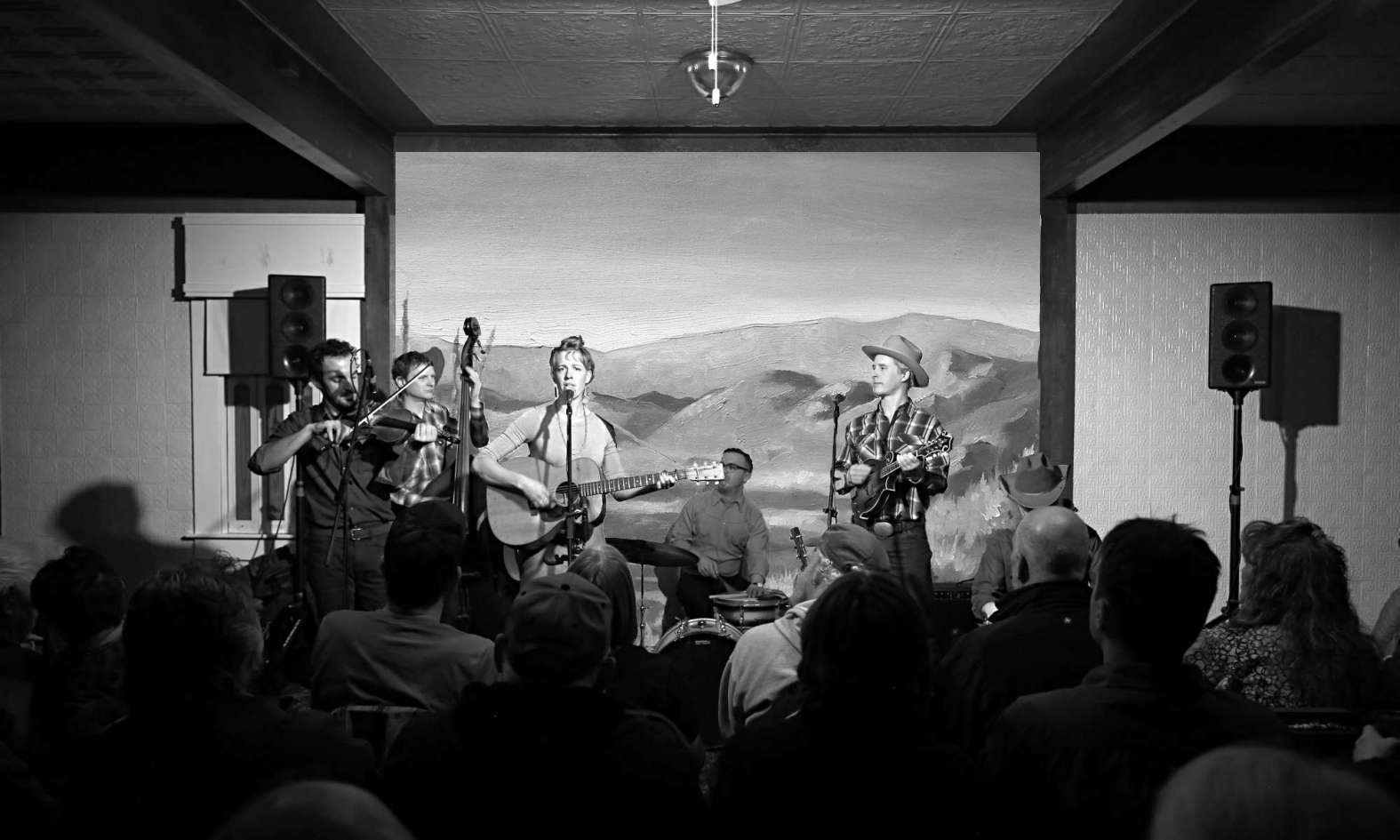
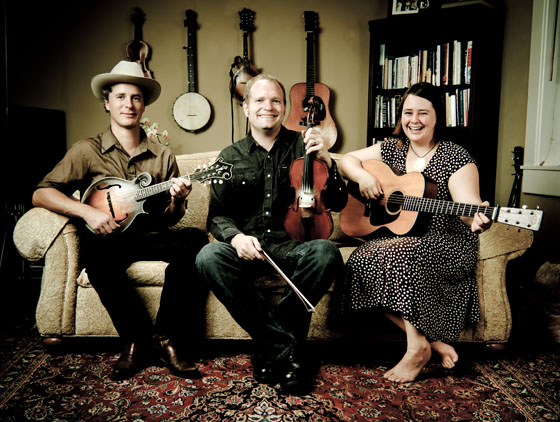
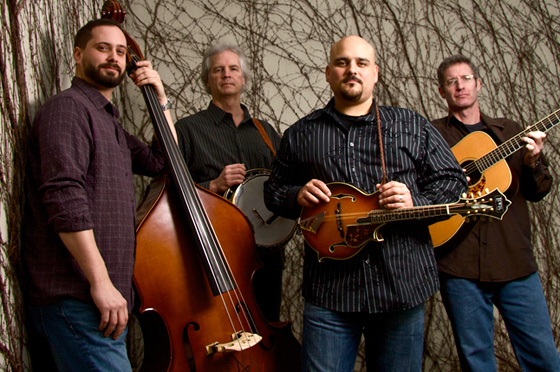
The Foghorn Stringband plays old time string band music deeply rooted in the American folk tradition. It’s a pre-copyright, post-bluegrass style, but the members of Foghorn put their own stamp on it. Stephen “Sammy” Lind’s fiddle and Caleb Klauder’s mandolin play tight unison lead lines anchored by the bedrock rhythms of Nadine Landry’s bass. It’s a sound that could be coming to you from a big console radio in a 1930?s living room, or an Appalachian front porch; instead it’s being delivered by a group of players from the thriving old time music scene of Portland, Oregon. Proof positive that folk music will remain vital as long as there are folks who want to play it.
Dedication to the music and the band’s sense of camaraderie marks every note the band plays, live or in the studio. Foghorn play in unison, gathered around a single mike, no flashy picking or solos, carried along by their driving rhythms and fierce determination to keep traditional music alive and exciting for this and future generations. The band’s genuine enthusiasm for the music keeps them a mainstay in the folk and old time music circuit.
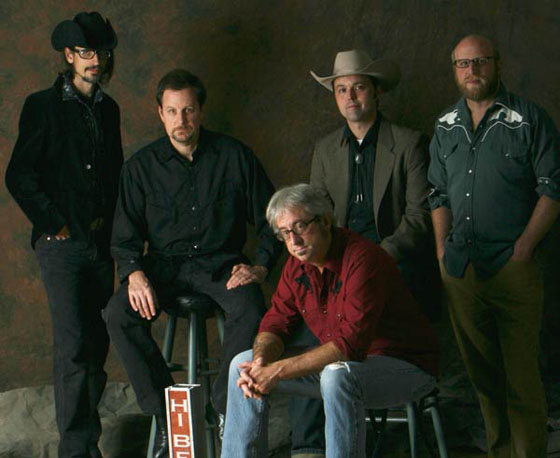
Halden Wofford and the Hi-Beams’ throwback and stylish take on the honky tonk genre is a breath of fresh air amidst other wannabe retro acts. With some of the choicest players on the Front Range and a professionalism that is bar-none, the Hi-Beams landed themselves on the famed NPR show “A Prairie Home Companion” in recent years and Wofford’s distinct vocals continue to garner the band well-earned attention. – Marquee Magazine, Boulder, CO
One of Colorado’s most popular and enduring acts, the Hi-Beams celebrate ten years together in 2010. Rootsy but not revivalist, the Hi-Beams’ rollicking stage act features rocked-up Texas honky tonk and western swing, equal parts original and classic.
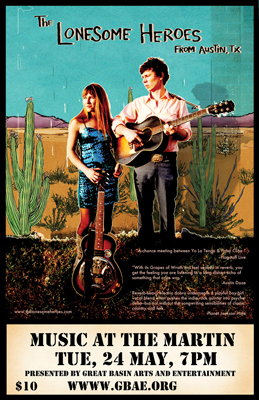
We are about to help the Lonesome Heroes add the Martin Hotel to their list of legendary venues, and Nevada to the list of 27 states in which they have performed. This show will also strengthen our connection to Austin, one of THE hotbeds of new music in America today. One thing always leads to another, and when Leo Rondeau got back home, he passed on the word about this great little venue out in the middle of the Great Basin.
The Lonesome Heroes extensive tour schedule is bringing them though Winnemucca, and after giving a listen, we were compelled to set up a show for them. We think you will really enjoy this young duo with their wonderful songwriting skills, plugged in dobro, and their interesting “”chance meeting between Yo La Tengo and Patsy Cline” approach to their music.
On this tour the Lonesome Heroes are:
Rich Russell – Dobro/Guitar/Vocals
Ms. Landry McMeans – Dobro/Guitar/Vocals
Chris Clonts – Harmony Vocals / Guitar / Keys
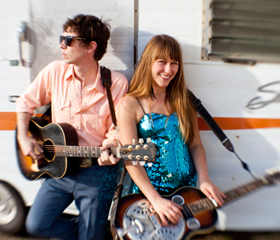
Proclaimed as “rewriting the rules of alt country” by the Austin Chronicle, The Lonesome Heroes have emerged as a singular talent out of Austin’s music scene. Songwriters Rich Russell and Landry McMeans founded the Heroes in 2005, and the pair has cultivated their Brooklyn and Texan roots into a unique sound that unites Indie Rock, Folk, and Country.
The Heroes’ songs evoke a Western Americana landscape littered with broken hearts, abandoned shopping malls, and crooked highways. Lonesome, yet hopeful, the songs call upon a wide list of influences to step beyond the alt country moniker. McMeans’ lilting voice, meshed with Russell’s drier vocals sits atop a multilayered nest of acoustic guitar, reverb-laden steel, and atmospheric sounds. The result is a haunting city-meets-country feeling that has been compared by Flagstaff Weekly as a “chance meeting between Yo La Tengo and Patsy Cline.”
Not the square kind of country, nor outlaw, or even contemporary country would fit The Lonesome Heroes. Reverb-heavy electric dobro underneath a playful boy-girl vocal blend pushes the indie rock quintet into psychedelia, but not without the songwriting sensibilities of classic country.
INFLUENCES:
Beck, The Silver Jews, Johnny Cash, Smog, Leonard Cohen, Bob Dylan, Wilco, The Velvet Underground, Band of Annuals, Graham Parsons, Lil’ Cap’n Travis, The Magnetic Fields, Neko Case, Hank Williams, Luna, Jan Bell, Yo La Tengo, The Flaming Lips, The Weary Boys, Patty Griffin, Herman Dune, Galaxie 500, Jolie Holland, Kris Kristoferson, The Darling New Neighbors, Will Oldham, Leo Rondeau, Woody Guthrie, Gillian Welch, Lou Barlow, Iron and Wine, Emmylou Harris, The Flying Burrito Brothers…
Jeff Johnston: Electric Bass & Saw.
Jim DeGregorio: Upright/Electric Bass, Banjo.
Chuck Fleming: Drums.
Sarah Stollak: Fiddle
Chris Clonts: Electric Guitar, Harmony Vocals.
Kullen Fuchs: Trumpet, Vibraphone, Keys, Accordion, & textures.
TOURING:
The Lonesome Heroes play 150+ shows a year both locally and nationally. Playing listening rooms as a two piece and large clubs and festivals with their 5 piece touring band.
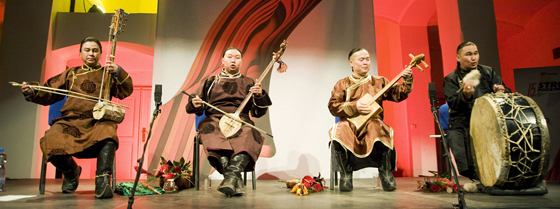
Alash is a quartet of master throat singers (xöömeizhi) from Tuva, a tiny republic in the heart of Central Asia. The ancient art of throat singing (xöömei) developed among the nomadic herdsmen of this region. Alash remains grounded in this tradition while expanding its musical vocabulary with new ideas from the West.
Background: All members of Alash were trained in traditional Tuvan music since childhood, first learning from their families, and later becoming students of master throat singers. In 1999, as students at Kyzyl Arts College, they formed a group called Changy-Xaya. They practiced in the damp college basement on Kochetovo Street, and soon became the resident traditional ensemble on campus. At the same time they learned about western music, practiced on hybrid Tuvan-European instruments, and listened to new trends coming out of America. Alash. Tuva. 2002 Under the guidance of Kongar-ool Ondar (best known to western audiences for his role in the film Genghis Blues), they began to forge a new musical identity. They introduced the guitar and sometimes even the Russian bayan (accordion) into their arrangements, alongside their traditional Tuvan instruments. They experimented with new harmonies and song structures. The effect is an intriguing mixture of old and new.
Influences: The musicians are inspired by the music of their grandparents, great-grandparents, and the great musicians of Tuva and Central Asia. At the same time they are influenced by such western artists as Sun Ra and Jimi Hendrix. Yet the Alash musicians never sacrifice the integrity of their heritage in an effort to make their music more hip for an American audience. Rather they look for contemporary ideas that mesh well with the sound and feel of traditional Tuvan music.
Alash in America: Alash’s inaugural U.S. tour was sponsored in 2006 by the Open World Leadership program of the Library of Congress and the National Endowment for the Arts. Since then, they have returned to tour extensively, playing to enthusiastic audiences and presenting workshops to eager students of all ages. The Washington Post described their music as “utterly stunning,” quipping that after the performance “audience members picked their jaws up off the floor.”
Alash Collaborations: Members of Alash enjoy working across musical genres. They have collaborated with such diverse groups as the innovative jazz ensemble Sun Ra Arkestra, the bluegrass/fusion/jazz band Béla Fleck and Flecktones, and the classical Chamber Music Society of Lincoln Center’s Student Producers Program. They are guest artists on the Grammy-winning holiday CD “Jingle All the Way” by Béla Fleck and Flecktones.
Awards: Both the Alash ensemble and individual members have consistently won top honors in throat singing competitions. The ensemble was awarded first prize in Tuva’s International Xöömei Symposium competition in 2004. At the Fifth International Xöömei Symposium in 2008, three Alash musicians swept the top prizes for individual throat singing, and the fourth took top honors for his duet performance with his wife. In 2007, Alash member Bady-Dorzhu Ondar was named People’s Xöömeizhi of the Republic of Tuva, the youngest person ever to receive this prestigious award. In 2009, Alash member Ayan Shirizhik was named a Merited Artist of Tuva. Even Alash’s American manager, Sean Quirk, was named a Merited Artist of Tuva for his contribution to Tuvan culture. In addition, Quirk and all Alash members play in the Tuvan National Orchestra, which has won both first prize and grand prize in the All-Russia National Orchestra and Ensemble Competition.
After six years with the US Navy’s elite bluegrass band Country Current, Frank Solivan, master fiddler and mandolin-player, is out on his own with signature passion and precision. With Washington D.C.-based Dirty Kitchen — an impressive rotation of musical powerhouses, including Mike Munford (banjo, vocals) Stefan Custodi(bass, vocals) and Lincoln Meyers (guitar,vocals)– Solivan builds on his smart, heartfelt style. Raised in the bluegrass tradition from California to Alaska, Solivan has been an award-winning musician almost since he was old enough to hold a fiddle, as well as a key mentor to some of bluegrass’s young stars. He lives with his wife, Leah, in Alexandria, Virginia where, when he isn’t playing and singing he can be found in his own (usually clean) kitchen.
Frank Solivan has opened for Reba McEntire, Brooks and Dunn, Odetta, Allison Krauss and Roseanne Cash. He’s been invited to sit in with David Grisman, Peter Rowan, Tom Paxton and the Infamous Stringdusters. Solivan has played all over the country for audiences from the Alaska Folk Festival to the National Mall on the Fourth of July, to the Gettysburg Bluegrass Festival, the California Bluegrass Association’s Grass Valley Festival, the Kennedy Center and the Grand Ole Opry. Solivan has recorded with Rob Ickes, Byron House, David Grier, Kathy Chiavola, Shadd Cobb, Jesse Cobb, Arlo Guthrie, Terry Eldridge, Megan McCormick, Ginger Boatwright and the late great John Hartford.
$15 Tickets are ON SALE NOW
at Nature’s Corner, The Martin Hotel, and Global Coffee
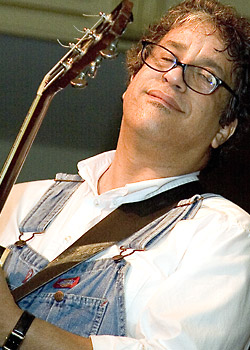
The look on Chris’ face in this photo tells the story. This is Chris clearly in his grove, the almost trance like state that he enters when he simply lets the sound carry him along. We often talk about the magic that often happens at the Martin, and Chris can really bring it.
Chris’ Bio:
Chris Cain’s jazz-tinged, blues soaked guitar and deep, warm vocals have the maturity and authenticity of bluesmen many years his senior. His expressive style is the result of a lifetime of study and the relentless pursuit of music mastery. His passion and intensity are a blend of his mother’s Greek ancestry and his father’s soulful black heritage.
Cain was raised on stories of his father’s childhood upbringing on Memphis’ Historic Beale Street and attended his first B.B. King concert at the tender age of three. Blues music played continuously on the home stereo and family outings were often trips to concerts. Cain recalls, “I remember when I was a kid, my Dad would be mowing the lawn with the stereo blasting Muddy Waters. When I look back, that was pretty cool! There was always music playing at our house, Ray Charles, B.B. King, Freddie King, Albert King, all the greats.”
At the age of eight, Cain taught himself to play guitar and began playing professionally before he was eighteen. Chris studied music at San Jose City College, and was soon teaching jazz improvisation on campus. Over the next twenty years, Cain would also master piano, bass guitar, clarinet, alto and tenor saxophone. The combination of his blues upbringing and his jazz studies melded to form the searing guitar style that sets Chris Cain apart and has moved him to the top ranks of the blues music scene.
Cain’s debut recording, Late Night City Blues (Blue Rock’it Records-1987) garnered four W.C. Handy Blues Award nominations, including “Guitarist of the Year”. Dan Forte of Guitar Player wrote, “An impressive debut album by a top notch guitarist.”
Cain’s next two releases; “Cuttin Loose” (Blind Pig Records-1990) and “Can’t Buy a Break” (Blind Pig Records-1992) collected a long list of awards and accolades. In August of 1995 Blind Pig released “Somewhere Along the Way” his 4th compilation of his unique brand of original music sophisticated blues, funk, jazz and gospel.
In 2003 Patrick Ford produced Chris’s latest CD, “Hall Of Shame” (Blue Rock’it Records-2003). “…this is now the sixth Chris Cain solo release I have produced, not to mention his work with me on projects like the Ford Blues Bands’ “In Memory Of Michael Bloomfield” CD, and I continue to be in awe of his incredible talent. As a guitarist/singer, Chris has been praised by mentors like Albert King and peers like Robben Ford.”
Larry Nager (syndicated Scripts-Howard music critic) writes, “Nowadays most young blues players are Strat-wielding Stevie Ray Vaughan-a-bes. Not Chris Cain. With a voice that recalls B.B. King and a thick toned Gibson guitar sound reminiscent of Albert King, Cain is forging a unique style. With his own highly personalized songwriting, “Hall Of Shame” is a giant step in the development of one of the most compelling young bluesmen on today’s scene.”
Through his guitar mastery and remarkable songwriting ability, Chris Cain has established himself as a musical force to be reckoned with. And as San Jose Mercury News music reviewer John Orr writes, “more than anyone else, anywhere, Chris Cain represents the future of the blues.”
Songwriter and multi-instrumentalist Harvey Reid has honed his craft over the last 35 years in countless clubs, festivals, street corners, cafes, schools and concert halls across the nation. He has been called a “giant of the steel strings” and “one of the true treasures of American acoustic music.” He has absorbed a vast repertoire of American contemporary and roots music and woven it into his own colorful, personal and distinctive style. His 22 recordings on Woodpecker Records showcase his mastery of many instruments and styles of acoustic music, from hip folk to slashing slide guitar blues to bluegrass, old-time, Celtic, ragtime, and even classical.
Reid’s skills and versatility on the guitar alone mark him as powerhouse in acoustic music. He won the 1981 National Fingerpicking Guitar Competition and the 1982 International Autoharp competition. Yet he’s also a veteran musician with a long list of studio and band credits, a strong flatpicker who has won the Beanblossom bluegrass guitar contest, a versatile and engaging singer, a powerful lyricist, prolific composer, arranger and songwriter, a solid mandolin and bouzouki player, and a seasoned performer and captivating entertainer. And he plays the 6-string banjo and the autoharp like you’ve never heard.
Reid prides himself on his independence, and sees himself as a modern embodiment of the ancient minstrels. You’ll find elements of the traditional troubadour, the modern poet-songwriter, the American back-porch picker, the classical virtuoso, and even a good bit of Will Rogers style dry humor and satire. You’ll hear folk, country, classical, blues, ragtime, rockabilly, Celtic, bluegrass, and popular music influences. Although Reid has a vast repertoire of traditional and contemporary songs, his concert material consists mostly of his own compositions and traditional music.
The Foghorn Stringband plays old time string band music deeply rooted in the American folk tradition. It’s a pre-copyright, post-bluegrass style, but the members of Foghorn put their own stamp on it. Stephen “Sammy” Lind’s fiddle and Caleb Klauder’s mandolin play tight unison lead lines supported by Peter Leone’s three-finger banjo picking and anchored by the bedrock rhythms of Nadine Landry’s bass. It’s a sound that could be coming to you from a big console radio in a 1930’s living room, or an Appalachian front porch; instead it’s being delivered by a group of players from the thriving old time music scene of Portland, Oregon. Proof positive that folk music will remain vital as long as there are folks who want to play it.
Dedication to the music and the band’s sense of camaraderie marks every note the band plays, live or in the studio. Foghorn play in unison, gathered around a single mike, no flashy picking or solos, carried along by their driving rhythms and fierce determination to keep traditional music alive and exciting for this and future generations. The band’s genuine enthusiasm for the music keeps them a mainstay in the folk and old time music circuit.
Foghorn has toured extensively throughout the US, the UK, Ireland, Denmark, Sweden, Finland and Malaysia, playing a variety of stages including the Tonder Music Festival, the Newport Folk Festival, the Rainforest World Music Festival, the Chicago Folk and Roots Festival, Pick-a-thon Roots Music Festival, The Seattle Folk Life Festival, The Bristol Rhythm and Roots Festival, Bumbershoot and the ROMP Festival.
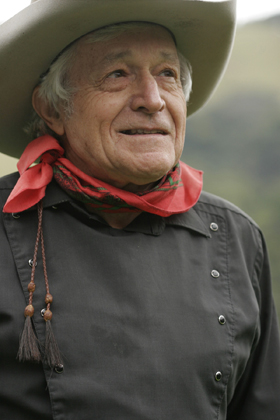
Ramblin’ Jack Elliott is returning to the Martin Hotel for a Great Basin Arts and Entertainment produced concert at 7:00 PM, Tuesday, January 25. Jack played the Martin just one year ago, on his way to Hollywood to pick up his Grammy Award.
This year he is returning, on his way to the National Cowboy Poetry Gathering in Elko, but he is bringing along two of the best sidemen in the business so he can perform some of the songs from his Grammy Award winning record. Van Dyke Parks will accompany Jack on the piano, and David Piltch will play standup bass as Ramblin’ Jack performs some of the classic blues tunes that formed the theme for his latest recording.
One of the last true links to the great folk traditions of this country, with over 40 albums under his belt, Ramblin’ Jack Elliott is considered one of the country’s legendary foundations of folk music.
“Nobody I know—and I mean nobody—has covered more ground and made more friends and sung more songs than the fellow you’re about to meet right now. He’s got a song and a friend for every mile behind him. Say hello to my good buddy, Ramblin’ Jack Elliott.”
– Johnny Cash, The Johnny Cash Television Show, 1969.
Long before every kid in America wanted to play guitar — before Elvis, Dylan, the Beatles or Led Zeppelin — Ramblin’ Jack had picked it up and was passing it along. From Johnny Cash to Tom Waits, Beck to Bonnie Raitt, Ry Cooder to Bruce Springsteen, the Grateful Dead to The Rolling Stones, they all pay homage to Ramblin’ Jack Elliott.
In the tradition of roving troubadours Jack has carried the seeds and pollens of story and song for decades from one place to another, from one generation to the next. They are timeless songs that outlast whatever current musical fashion strikes today’s fancy.
“His tone of voice is sharp, focused and piercing. All that and he plays the guitar effortlessly in a fluid flat-picking perfected style. He was a brilliant entertainer…. Most folk musicians waited for you to come to them. Jack went out and grabbed you….. Jack was King of the Folksingers.” – Bob Dylan, Chronicles: Volume One
There are no degrees of separation between Jack and the real thing. He is the guy who ran away from his Brooklyn home at fourteen to join the rodeo and learned his guitar from a cowboy. In 1950, he met Woody Guthrie, moved in with the Guthrie family and traveled with Woody to California and Florida, from the redwood forests to the Gulf Stream waters. Jack became so enthralled with the life and composer of This Land Is Your Land, The Dust Bowl Ballads, and a wealth of children’s songs that he completely absorbed the inflections and mannerisms, leading Guthrie to remark, “Jack sounds more like me than I do.”
In 1954, along with folksinging pals Frank Robinson and Guy Carawan, Jack journeyed south through Appalachia, Nashville and to New Orleans to hear authentic American country music. He later made this the basis for his talking song, 912 Greens.
In 1955 Jack married and traveled to Europe, bringing his genuine American folk, cowboy and blues repertoire and his guitar virtuosity, inspiring a new generation of budding British rockers, from Mick Jagger to Eric Clapton.
When he returned to America in 1961, he met another young folksinger, Bob Dylan at Woody Guthrie’s bedside, and mentored Bob. Jack has continued as an inspiration for every roots-inspired performer since.
Along the way he learned the blues first-hand from Leadbelly, Mississippi John Hurt, the Reverend Gary Davis, Big Bill Broonzy, Brownie Mcghee and Sonny Terry, Jesse Fuller and Champion Jack Dupree.
He has recorded forty albums; wrote one of the first trucking songs, Cup of Coffee, recorded by Johnny Cash; championed the works of new singer-songwriters, from Bob Dylan and Kris Kristofferson to Tim Hardin; became a founding member of Bob Dylan’s Rolling Thunder Revue; and continued the life of the traveling troubadour influencing Jerry Jeff Walker, Guy Clark, Tom Russell The Grateful Dead and countless others.
In 1995, Ramblin’ Jack received his first of five Grammy nominations and the Grammy Award for Best Traditional Folk Album, for South Coast (Red House Records). Jack was again recognized with a Grammy Award for best Traditional Blues Album in 2009, for A Stranger Here (Anti-Epitaph Records).
In 1998, President Bill Clinton awarded Jack the National Medal of the Arts, proclaiming, “In giving new life to our most valuable musical traditions, Ramblin’ Jack has himself become an American treasure.”
In 2000, Jack’s daughter, filmmaker, Aiyana Elliott produced and directed The Ballad of Ramblin’ Jack, her take on Jack’s life and their fragile relationship, winning a Special Jury Prize from the Sundance Film Festival.
Through it all—though agents, managers, wives and recording companies have tried—Jack resisted being molded into a commercial commodity. He played his shows without a written set list or including any songs that did not ring with his gut feeling of what mattered to him.
Ramblin’ Jack’s life of travels, performances and recordings is a testament to the America of lore, a giant land of struggle, hard luck and sometimes even of good fortune. Ramblin’ Jack takes us to places that spur us on to the romance and passion of life in the tunes and voices of real people.
At seventy-nine, Ramblin’ Jack is still on the road, still seeking those people, places, songs and stories that are hand-crafted, wreaking of wood and canvas, cowhide and forged metal. You’ll find him in the sleek lines of a long haul semi-truck, in the rigging of an old sailing ship, in the smell of a fine leather saddle.
BETTER YET, FIND HIM AT THE MARTIN HOTEL IN WINNEMUCCA ON JANUARY 25.
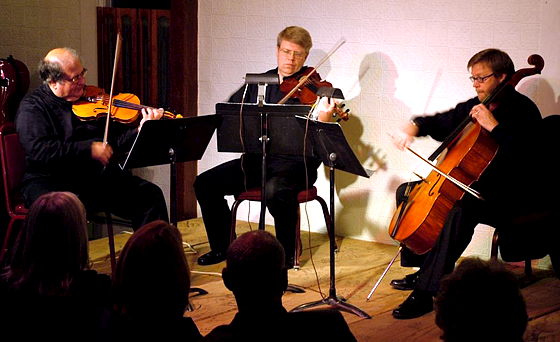
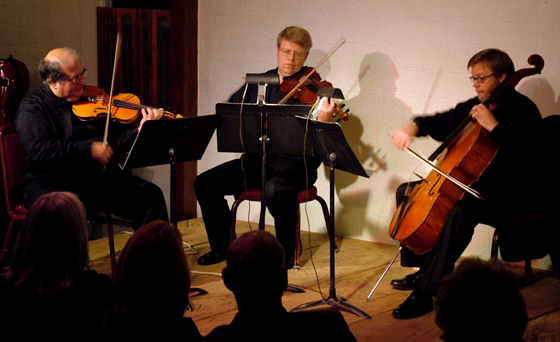
Established in 1991 the Langroise Trio are Artists-in-residence at The College of Idaho, where they form the string faculty. They have performed on chamber music series in Alabama, Florida, Idaho, Oregon and Washington, their fourth c.d. is in the planning stage, and the Trio was one of the first groups to give an “internet archived” concert on the Millenium Stage of the Kennedy Center.
With its personnel among some of the foremost musicians in the country, the Langroise Trio offers an eclectic repertoire. Contemporary works by Idaho composers Jim Cockey and David Alan Earnest have been written especially for them and they stylishly play music from the Romantic, Classical, Baroque and Renaissance eras as well.
Geoffrey Trabichoff is Concertmaster of the Boise Philharmonic. He is the former concertmaster of the BBC Scottish Symphony and former leader of the Paragon Ensemble of Scotland. Geoffrey has broadcast numerous concertos for the BBC. He has been guest concertmaster of the Royal Philharmonic and the London Symphony as well as the Northern Sinfonia, BBC Welsh and BBC Philharmonic Orchestras. He also served as concertmaster of the Mannheim Chamber and Hanover State Orchestras in Germany.
David Johnson has been principal violist of the Iceland Symphony and the Ft. Wayne Philharmonic, and a member of the Freimann Quartet. David was assistant principal violist for the Grant Park Symphony in Chicago and holds a Master of Music degree from Indiana University. He has been a featured soloist on numerous occasions and a featured artist on Iceland National Radio Broadcasts.
Samuel Smith has been principal cellist of the Ft. Wayne Philharmonic where he was a frequent soloist and a member of the Freimann Quartet. Samuel was also a cellist for the Grant Park Symphony of Chicago. He has served as assistant principal cellist of the Florida Symphony, and has been on the adjunct faculty at Anderson College and the summer faculty at Ball State University.
This project is funded in part by a grant from the Nevada Arts Council, a division of the Nevada Department of Cultural Affairs, and the National Endowment for the Arts, a federal agency.

 Cain’s debut recording, Late Night City Blues (Blue Rock’it Records-1987) garnered four W.C. Handy Blues Award nominations, including “Guitarist of the Year”. Dan Forte of Guitar Player wrote, “An impressive debut album by a top notch guitarist.”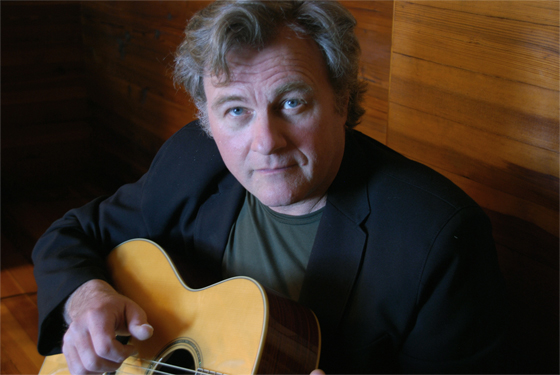

 Foghorn has toured extensively throughout the US, the UK, Ireland, Denmark, Sweden, Finland and Malaysia, playing a variety of stages including the Tonder Music Festival, the Newport Folk Festival, the Rainforest World Music Festival, the Chicago Folk and Roots Festival, Pick-a-thon Roots Music Festival, The Seattle Folk Life Festival, The Bristol Rhythm and Roots Festival, Bumbershoot and the ROMP Festival.